Support TER Podcast at www.Patreon.com/TERPodcast
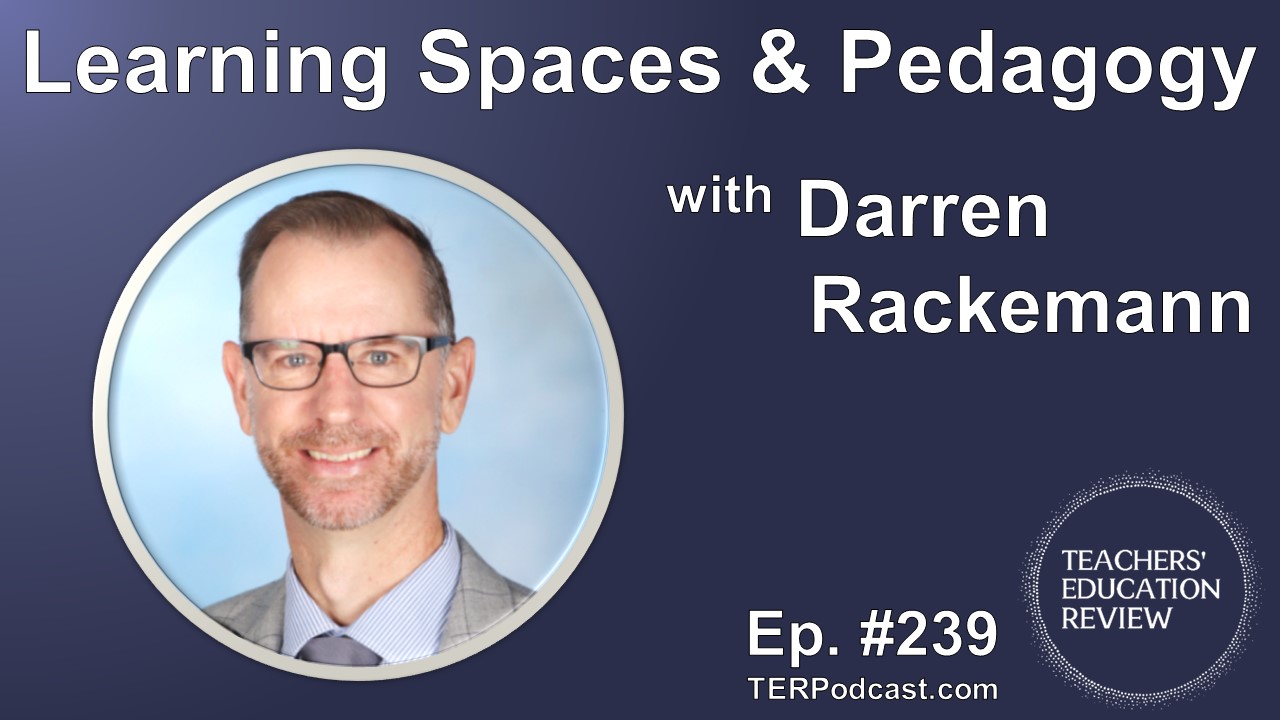
Steven Kolber talks to Darren Rackemann about his experiences and insights into middle years leadership and education, focusing on developing collaborative learning spaces and engaging students. They discuss an innovative alternative programs for year 9 students that provides authentic, project-based learning experiences through partnerships with local organisations, and how his school approaches co-teaching, flexible learning spaces, and using technology to enhance learning.
Kolber’s Corner – Steven Kolber
Ideology in Education – Tom Mahoney
Tom Mahoney’s The Interruption
Education in the News – Cameron Malcher
Does a public school education in Australia really cost $93k?
A battle is brewing over public school funding. Here’s what’s happening and what could come next
Timecodes:
00:00 Opening Credits
01:31 Intro
04:18 Ideology in Education
14:31 Education in the News
36:22 Feature Introduction
38:55 Kolber’s Corner
41:31 Feature Interview – Darren Rackemann
01:37:42 Patreon Shout-Outs and announcements
Read More for transcripts.
Feature Interview Transcript (unedited, prepared by Otter.Ai)
Click here for interactive transcript.
Steven Kolber
Everyone, welcome back to the TR podcast, I’m sitting down with Darren recommened, who’s joining us on behalf of adolescents success. He’s one of the heroes one of their amazing outstanding leaders in the middle years space. So we’ll be talking to Darren about what that looks like in a school. So Darren, just for context was spoken to Liz Benson first. And we did spoke to Deb Evans. So they’ve given us kind of the, the organizational overview, and the kind of middle years middle leadership, how those come together, you’re gonna give us I hope, the kind of the leadership side what that looks like, as a school, there was a lot of a lot of theory of, you know, what it should look like, what it could look like, and place pedagogy, and other things that have had since slipped my mind, but hopefully, you can bring it down to the ground for us a little bit, especially for teachers and educators and researchers who are interested in the space. So just give us a bit of a, you know, back of an envelope version of your career, and what sort of led you to here so we can get some context. Yeah, sure.
Darren Rackemann
Thanks for your time tonight been teaching for 25 years plus, here on the beautiful gold coast for 17 years or so was in state education, then did a little bit of my own sort of consultancy work for a period of time. And as most consultants find, money can be difficult through the school holiday break when you consulting in the school environment. So I got back into schools and moved into the independent sector where I’ve been at Hillcrest Christian College for about the last seven or eight years now. And I’ve been through a few different roles. But most of my life, I’ve been a secondary teacher and leader, but always extremely passionate about the middle years. And I was very, very fortunate to win the head of the middle learning community role at Hillcrest about four years ago, right when this wonderful thing called COVID-19 came onto the scene. So the plan was to have a year to get everything set up and developed a really well. But the majority of that year, to be honest, was supporting exact members worked through COVID at our site. But it still gave me a great deal time to get our middle learning community established, which was a massive sort of renovation as part of that. And so our middle learning community at Hillcrest has been up and running for the last three years. So I’ve been really, really excited to be a part of that. And just recently, since mid year, I’ve moved into a role where I’m aligning the college and working in the middle years. And our year nine project, which sees our year nine students learn at Coolangatta at the beach, and then our senior years, which is now 1011 and 12. So I’m now looking after years five to 12, which is keeping me nice and busy. Right. Okay.
Steven Kolber
Gotcha. And how did you sort of become a middle years expert? Was that kind of your career led you that way? Or it was sort of a position you fell into house? Because for me from my I’m a high school teacher from way back, it’s not something I would have even thought was an option when I was training, at least for sure. So how about for you?
Darren Rackemann
Yeah, I think it was something that I just fell into. I think in my early early years, I was sort of the one that got the the the nine classes, particularly those Friday afternoon math classes, I seem to do a good job engaging with the students of that age, and actually used to really, really enjoy it. So I probably enjoy teaching year nine just as much as moving on and teaching year 11 and 12 later in my career. So always be really passionate about working with the sort of younger students. And yeah, I was very lucky to move to varsity college here on the Gold Coast, which was a purpose built school around middle schooling. So it had that sort of middle schooling precinct that was set up. So that was really, really a great experience, to work in that sort of an environment. And then now to move into an independent sector where I’m at a truly independent school. So we have a lot of freedom to do some really, really interesting things.
Steven Kolber
Yeah, right. And so take us to the United math class. What are what were you doing that was engaging?
Darren Rackemann
Odd, I don’t think anything. I think it was all about the three R’s of relationship, relationship relationship, just just talking to students, getting to know them really, really well. Just trying to make learning as real world as possible, which is one of those things that we sort of talked about as teachers, often I think we have fairly inauthentic real world learning. But always trying to bring the outside in and doing simple things like going and doing maths outside instead of doing maths on on a chalkboard when I first started teaching, which seems like a long, long time ago.
Steven Kolber
That’s often been my push kind of, you know, even the idea of leave the classroom seems a little bit a little bit out there these days. All right. And so you’ve always been around the Gold Coast are you moved around in new times.
Darren Rackemann
I’ve always been on the Gold Coast. It was when I actually graduated out of university, it was the least favorable region to move to in Queensland. So I thought it’s very close to Brisbane where I went to uni. So I’ll move down the Gold Coast one hour down the down the highway. And yeah, now lived here more than anywhere else I’ve lived in my life. And yeah, absolutely love it to a fantastic place to be.
Steven Kolber
And talk to us. How did adolescence success and your school come together? Was it you’re doing great stuff? Or you heard about them? Or vice versa? How do those sort of two Cs come together?
Darren Rackemann
Yeah, when are formally known as the middle years, I am why. So I’ve been to a few conferences, a long time back as a teacher. And then when I sort of moved into the the middle years, particularly Hillcrest Christian College, I sort of reached out and said, I’d like to be part of this and really support the organization and really help drive almost like a bit of a regional sector approach here on the Gold Coast, in many different ways, not just middle schooling. And the Gold Coast seems to be a sector that really is quite collaborative and gets on really, really well. I’ve been in the Microsoft educational community for a long time. And they always talk about the sort of southeast Queensland and particularly the Gold Coast region as an area that does a great job of working together and reaching out and supporting each other. So I guess I’m really passionate about middle schooling and want to try and support others within this region as well. Gotcha. And
Steven Kolber
so for those not familiar, the Gold Coast, if you were to sum it up in a, in a short little five minute spiel for us, like are we talking a big town, big city, small city like and what what kind of impact does that have on on your students in the school in the setting and those sort of things?
Darren Rackemann
Yeah, the Gold Coast is, it’s a really, it’s almost like a really little city. It’s almost like a country town in some aspects. Particularly when you when you think of that sort of beach culture, and every single bit of couple of kilometers, there’s a different surf club. And the Gold Coast is quite sort of territorial, where people stay in their suburbs. So even though it’s a really long, thin piece of Australia, people tend to sort of stay in their own suburbs. So it’s interesting that how small the Gold Coast does feel, while also being I think it’s the sixth biggest city in Australia. So, yeah, when it comes to the education sector, just like many of the other sectors, it seems to be a city where people do try to support each other, particularly with your neighbors across the fence.
Steven Kolber
Gotcha. And in terms of your personal beliefs on teaching and learning, obviously, we’re starting to get a taste of that sort of authentic learning and your areas maths and science as well, or just maths and you’re a big technology sort of person. Talk us through sort of your, your own mentality as a teacher, and now as a leader, I guess.
Darren Rackemann
Yeah, well, I’ve always been really, I’ve always seen the benefits of digital integration with learning. So I’ve always tried to use technology to our advantage. So yeah, maths and science, trained math, science backgrounds, but very much more of a pure sort of math teacher. In the early days, you get asked to teach anything. So I’ve taught some TV and music and all sorts of things. But maths was definitely the passion. But I guess, digital integrations really been a passion as well. So looking to the future. And when I saw chat, GPT burst onto the scene straightaway, that was something that energized me. That’s, that’s the world that I think we need to be working in. Not something that scared me. And I certainly wasn’t a person. And I’m lucky to be at a college where we had a very positive approach to it. And we looked at how do we how are we going to engage this because this is the world we live in. So yeah, I guess my own philosophy has always been about trying to use technology to to leverage quality learning and to help get our students ready for that future that we keep hearing is continuing to change.
Steven Kolber
And as as as a school as a leadership team, how have you sort of approached check GPT and other tools?
Darren Rackemann
Interestingly, here on the Gulf Coast, in our region, many many schools have had a negative you are not allowed to use chat, GPC. We’ve probably been in the minority where we’ve been like why doing that, let’s get in and teach our students the ethical way to actually use it. Because it opens up a whole lot of awesome learning about when you see something online. Is it real or is it not? And there’s some great conversation that can happen from that. So yeah, as a leadership team, we’ve we’ve had many sort of Twilight PD sessions after school that has focused on how are you as teachers using this in the classroom? How are you now starting to create models to help with feedback? Some teachers have really got some really, really refined and ways of now marking and offering feedback as part of the process of feeding back to students. So to help them learn, if you can provide a tool that students can use 24/7, then you’re giving access to learning, instead of just waiting to see your teacher maybe in three years time in the classroom and put your hand up and wait to ask a question, to
Steven Kolber
talk me through the Twilight PD. So we talk in Twilight, as in nighttime, surely teachers don’t go to those.
Darren Rackemann
We try to have one, maybe two, one or two or term where we do a little bit of an extended PD. Because, as we all know, it’s really hard to get into some meaty conversation with maybe a half an hour after work or something like that. So yeah, once a term we do about a two hour deeper dive. And this year, in particular, some of our incredible tech tech leaders have all taken different turns out offering a really differentiated approach. So teachers have signed up to the sessions that they want to go and be a part of. And we’ve been very lucky as a fairly big Microsoft school to have Microsoft support and send a few people into to support that as well. But there might have been 10 different sessions happening every half an hour that teachers were sort of picking and choosing what they’d like to go on and learn more about with a lot of that being based around sort of AI tools.
Steven Kolber
Yeah, okay. All right. And in terms of as a policy, your schools, you said, you’re focused on the ethical elements, is there like a policy that says how it should be used? Or is it sort of carte blanche to just have a go and sort of work out the way from there?
Darren Rackemann
Yeah, it’s still still in development, we’re probably a school that jumps in and trials things and then sort of then steps back and builds that as we go. And tries to reach out and look for those other critical flattened friends to do things with a really highly innovative college is fantastic. But then other times, it’s difficult to find those sort of other critical friends to go along and do the journey with you. So yeah, we’re very lucky to work for an executive head who really wants us to push the envelope. And which, which is fantastic. But yeah, they also and it’s great sometimes to have those other schools to do those learnings together. And so at the moment, I guess, we’re talking about a few different tertiary organizations even about researching and, and sort of following and doing journeys with the tertiary level, about how we can try and work together and drive some things forward around learning in particular, around pre service teacher training, we’re really interested in seeing if we can change the way that pre service teaching, I’m teacher trainings happening at the moment in tertiary lands, because when a pre service teacher comes to a renovated carpark and walks in and says, Well, I didn’t learn anything about how to work in a space like this, and to co teach with 80 students, three different classes all together in a big open plaza style learning environment. Or something that we feel like we can sort of maybe help a tertiary using our site as some stimulus to work into their program.
Steven Kolber
Sure. So I guess yes, start let’s start off with the place before we go to the IDE, but talk us through what kind of how does it play out? How does a car park become a classroom? And how do you manage all that? And what was it 8080 students? How many teachers um, my head’s still spinning, I’m overwhelmed. With 25 in one teacher, that’s how we do it talk us through the car park and how that came to be a classroom.
Darren Rackemann
Yeah, I guess it’s our executive has a really big vision. Jeff Davis, incredible leader that I’ve worked with previously. So I’ve worked with him for about 15 years now. Our preppies ones and twos learn in a castle. They have a moat around their classes, they learn on a beautiful natural lake on our site. The car park renovation came from really, really fast growth or college was just growing so exponentially, that you can fall into that trap of just building more buildings on your green space and losing overall space to run around and play, which is really, really important when you look at physical well being. So we had to look at innovative ways of creating learning spaces. And we just happen to have a building that was a double level multipurpose car park with a basketball court area on that third level at the top. And executive head and some board members went for a quick tour over Europe and looked at some really innovative schools through Europe to to look at what the future of classroom design looked like. Because we wanted to renovate not just continue to build boxes, or I call it the bells and sells model. We wanted to try and do something different that would allow us to have a space that would be still relevant in sort of 10 to 15 years, rather than going and building in boxes everywhere. So our first level of our car park was renovated about seven years ago. It was wildly successful and the board said Do the bottom level. Now again, I was very, very lucky that that bottom level was renovated. And then that created two levels of our middle learning community. So our fives and sixes learn collaboratively on one level of a carpark. And our sevens and eights learn Kreil collaboratively on the bottom level of our car parking. So two levels together with almost 600 students learning in what was just beautiful, big open space. Right?
Steven Kolber
I guess you don’t mention the car park part anymore for the school tours.
Darren Rackemann
We normally walk parents through every week and 10 minutes in we say this used to be a callback, and they wouldn’t believe it, if we didn’t tell them. The only thing that gives it away is that the ramp still goes up to the second level. So when you actually physically walk the ramp, that’s when everyone goes ah, now I can see I can’t
Steven Kolber
find my class, or you’re in carpark too. And then, sort of because as I said to you, before we started, I saw the YouTube videos or the car park and then the level itself. And so in an audio format, how can you sort of walk us through what it looks like once you get in
Darren Rackemann
the car park? Yeah, obviously, obviously, when you think imagine like a maya style Massive Open carpark. And so you do have pillars, that you’ve got to sort of work into some walls, but you have an ability to create large open spaces. And so I guess the approach is a large open plaza style collaborative spaces, where we often have three classes working together and co teaching model. But then we also have smaller little spaces that you can retreat to. So it’s basically setting up physical zones. And the style of learning we use is we actually start in those little corner II sort of zones, which are really only about 25 square meters. So quite small, and deliberately small, so you don’t want to stay in there. But it might sound strange that in a five by five little box, you can actually normally fit two classes in there at once, for a really short period of time. So you and I might be delivering maths together to two classes, we can bring them in and give the same message to both at the same time. And then we can set up what our learning is going to look like when we then step outside and collaborate. And you might be working with some differentiated students at a different level to myself. So it’s more about us together owning the 50 odd students between us more than the students necessarily having one of us for the entire year. It’s more of a team approach, where you and I as the teachers would own those sort of 50 students. And that allows us to continue to keep differentiating using pre testing, post testing, setting up different sort of learning environments for our students.
Steven Kolber
Okay. And so we’re talking big round tables, sort of. And so there’s the smallest spaces and the bigger players or spaces. And Do do you find you need to attract a particular type of teacher or something? Because as you say, it’s probably not the norm. I’m using myself as the lazy example. I’m used to 25 in one room, blah, blah, blah. But that’s, you know, probably the dominant discourse, which is why I’m setting myself up as the Patsy. Yeah, do you have to recruit a certain type of teacher is it just sort of a skill set that you can develop?
Darren Rackemann
If you walked in and had a look at our space, and you needed that bells and sales model where you walk in, shut the door, and you don’t want to collaborate, you would hate to work at our college. So we certainly do attract people that want to have an innovative approach to the pedagogical practice. And we do have to spend a lot of time practicing that and working on that. So it’s a major focus of our staff professional development. And it was a really interesting journey for me as a leader that in year one, because this middle community came in the middle of what was a primary and secondary school, we had to take staff both were primary trained and secondary trained. So in that first year, it was very much about building team culture. And that was the basis of the success we feel because we really focused on team culture as our number one priority above everything else. And then once we had a team where people were really willing to work with each other, and for each other, that’s when then that co teaching and pedagogy could really start to be enhanced. And through year two, and this year into year three, we’ve seen a real improvement and growth of what people are willing to take risks and to try different things. Because I’ve got a real team dynamic where they trust each other. Gotcha.
Steven Kolber
And so it doesn’t sound like you’ve got a top down pedagogy with that in mind, it’s more of a format as you go, I’m imagining.
Darren Rackemann
Yeah, when we talk co teaching, we don’t say this is the one model you must use. We talked about these are different models of coteaching. And you need to choose the model that’s going to work for you. Because in our big open carpark renovation every single room is slightly different. So 12 classes in total, if you can think of four different corners of the building has three classes working together, sometimes the teams will say, Well, can I use that corner because it’s physically set up in a way that will lead more to the learning we want to do with our team. So a highly collaborative environment where staff are working together really, really closely, and sort of CO designing that learning experience with their students. So it’s not a you must always parallel teach. And that is what we focus on for our co teaching. It’s, these are the six or seven different ways you can co teach. And we will always look at all of these different ways and and that then allows the small teaching teams to pick and choose how they want to set up their learning in the physical space. Gotcha.
Steven Kolber
And in terms of just practicalities, noise, I imagine a car park roof probably isn’t too low or too high, or, you know, lofty or anything, how do you how does the space managed with sound and having that many people in it at once, as a sort of survive?
Darren Rackemann
Yeah, I’ve been very strategic in the amount of time I have all 12 classes on the one level. So if you can imagine that we’re working in teams of three, you can have three outside doing PE, so straightaway, that creates more space. Sometimes it might be three out doing PE and three out doing design and engineering in different labs. So this is very much just for the core learning. So we tried to create a very flexible timetable where rarely is all 12 classes in there together. But it’s also set up in a way where there’s lots of movable glass walls. So you can sort of split the really large spaces in half and have people working where there are sound barriers. And it’s also just about sort of using furniture as well to your to your aid, you can use furniture to dampen sound, to set up little hidey holes and, and things like that. So you definitely need the right furniture. But acoustically, we’ve done a few different things to make the sound levels, quite reasonable are fives and sixes even go to the level of having decibel monitors on their TVs that they together the staff and the students come up with an agreed target. And they have the little app go off and go shoot if it gets too loud. So at the start of the lesson, they’ll have an agreement about how noisy should we be right now. So you can actually have the students be part of that learning, as well. Yeah, right.
Steven Kolber
And let’s flip flip back to the earlier point, which is the it did you was it Griffith University that I get that right? Can you tell you my bed mixed up? And so how, what are you doing in this sort of ita space to kind of bridge that gap? How does that work? How do you build that that sort of a, I guess what is it a partnership model? I know that’s often the kind of language people use.
Darren Rackemann
Yeah, I started Qt in Brisbane, but we’re probably doing more work with our local Tertiaries. Down on the Gold Coast. We started with quite a bit of work with Southern Cross University, which is right next to the airport at the Gold Coast if you’re ever flying in and out. And that’s come around because of our year nine project, which is the RISE program down at Coolangatta. CEU, were incredibly helpful to us about letting our United students use their facilities while we were getting ready for that program this year. So we’ve struck up a really nice partnership with them, as well as the local Coolangatta surf club. So they probably have two major partners of that you nine RISE program. So we’re trying to now just create that as a more of a win win relationship with with Southern Cross University to look at. Yeah, how do they do teacher training? How can we input into that? We have a really, really alternative way of learning without your nines down at the beach. And they’re quite interested in how can their pre service teachers be seeing that experience as part of their program? Yeah, right.
Steven Kolber
Right. So talk me through the the RISE program, program or project. How’s that? And how is that learning different?
Darren Rackemann
Yeah, so I guess I’m middle learning community. I don’t think I mentioned that. It’s actually it’s 5678. So everyone talks about middle schooling in a different sort of age bracket. So we have a we have a junior that goes from prep to four and then our middle Learning Community is five to eight, and our senior was nine to 12. And most secondary teachers would know that year nine is a really tricky year level. There is a ton of research online that openly shows that students in year nine can really struggle for many different ways, not just puberty. It’s when social media can sometimes starts to get dark. There’s statistical increases in bullying. So it’s most people that have been teaching for a while always talk about needing to do something different in that sort of for early teenage years, but very few people do something different about it. So we took a large leap this year, and we started this completely alternative program at year nine, our students traveled by bus about 25 minutes down the highway to Coolangatta beach. And we’ve leased space in a shopping center. So our kids go to school in a shopping center, they walk up the travelators pass Woolworths. And this it’s an converted call center, which looks really, really similar to the renovated carpark they’ve just come from. So for our students, it’s nothing different. When parents and guests come in, they say what are you doing? It seems crazy, but our students walk in and go, this is just like life back on school. But we’ve tried to have a complete project based learning approach to that learning. So for instance, being on the beach in turn, one we pulled together Math, Science HPE. And we created the run project. So the students were running down on the beach, but they were using Australian Olympians to train them on how to create running programs. And over eight weeks, they were tracking their data, their growth, would use that data in the classroom for maths. And so we were doing linear function work and a whole lot of things that were well beyond what we would normally be able to do with a year nine maths class. We were talking about homeostasis in science we were so we were building all of the learning in but the students didn’t really know they were learning because they thought they were just running around on the beach and having a great time. It was it was interesting how many parent emails I received at the start of the year, because parents were saying my child comes home and just tells me they run around have fun, when is the learning going to happen. So we actually had to start really sharing all of the Australian curriculum that was in all of our learning. And it was just it was contextualized in a way that was so engaging for the students. They just didn’t understand the really, really deep learning that was occurring. I mean, we were doing Misleading Graphs and things that I’ve never done a year nine level before, it’s probably been more your year 11 work instead of year nine. So there was a lot of guest speakers, and a lot of real world learning, which I was referring to earlier. This is truly authentic learning when they’re out there on the beach. Here on the Gold Coast, we have an incredible number of Olympians, and people that are really willing to put their hand up and come in and be a part of something different in education. So I think in turn one, we have 33 different guest speakers come through our program, and the students just love to hear somebody else, instead of you the title teacher that doesn’t know what they’re talking about. They love it when a guest speaker comes into the room, and there’s just silence. And so yeah, math, science, English, completely integrated through the run project. English humanities, we had a, an art gallery, where the students had to go and look at the historical figures around the local region of cool and data that had to go out themselves and organize setting set up meetings to go and interview them write feature articles about their subjects. And then they actually set up an art gallery over the Easter break in a local art gallery where the public could go and look at those public displays of learning. Local paper came through and couldn’t believe that the standard of work that the students had been producing from you nine local photographers came through and looked at the portrait photography the students had been using. And again, that was because it was as high level because we had mentors coming in. And teaching students something simple and new, like portrait photography, it might be that dot point from a car that you meant to do at your nine. But again, it makes it really engaging and real for the students. So it’s been a really wildly successful program in year one. And we’ve just started to roll through our second cohort, as we transfer as we transition our year eight students into that year nine program.
Steven Kolber
And you mentioned the Australian curriculum. So is this kind of you taking a light touch approach? Or is it all being delivered just in ways that are sort of different I kind of thinking of my own teaching of you and I it was definitely a light touch at times when the when the purity kicked in, etc. Yeah, how do you sort of tie all that together? Like who did that? I imagine that’s big, big picture work to get all the dot points lined up in the right columns and all those sort of things. How does that? How does that come to be?
Darren Rackemann
Yes, I mean, Queensland our, our sort of national body that comes in and checks up on everything has, we actually had to have that unit on campus completely open as it took off as if it’s a brand new school. So I had to go through every single check and balances if it was its own school. We just went through a six month review process only a couple of months back and passed with flying colors. So we’re delivering the Australian Curriculum, ticking off all of the learning achievement standards as we shall be. We’re just packaging it together in a different way. And the learning has been that we’ve actually got through our student learning faster, because the students have been more engaged. And with that integrated approach, that’s been the biggest surprise for staff. There have been teachers of 15 plus years that are shocked how much history how quickly they’ve moved through the English standards, because of the way that we’ve been packaging it together. So it’s, it’s happened because it was a really quality teaching team. And again, we flipped everything on its head you nine often in a school gets timetabled last, we actually timetabled it first. So we had people put their hand up and apply to be a part of this program. And then we’ve supported them and train them at a really high level. So PBL works, probably the number one company around the world that really does incredible training around project based learning, we engaged with them. It’s not cheap, but the training was absolutely incredible. I did the three day PBL, one on one training with them. And it was probably the best professional learning I’ve done in a long, long time. So the staff have been really, really well supported. And it’s been an interesting approach to put together a really high performing team, and to really get leadership out of the way and to let them lead as a team. So there’s been a lot of leading from within, and people just working really hard to support each other. Gotcha.
Steven Kolber
And is part of the pitch that they have lunch at the food court or how does
Darren Rackemann
it’s, it’s a pretty beautiful environment. So generally not at the food court, but are they do as cohorts go to the beach together, or there’s a beautiful massive park behind them the strand shopping center that it’s in. So a lot of outdoor. Again, for the for the teachers, it’s also about that well being component, different things like basically hardly any morning tea break at all large lunch break. And the reason for that is then you can get outside and do really different things that you can’t do a normal school. So our students are paid members of the local surf club, they can go out at one o’clock or sorry for that lunch break of an hour, and go and actually do things towards their surf certificate. So they become active patrolling members of the local surf club. So it’s quite unique to be in a school and be able to go and surf for 45 minutes and work on your board skills, and then walk back across the road to your school again. So we try to embrace the natural environment as much as we can. Yeah. Right.
Steven Kolber
And in terms of the this shopping center, that they’re a part of, is there been any other way? I’m obviously giving you all the all the annoying to the questions here? Or does they give that most obvious stupid things? But yeah, like, you know, we’d often hear reports about United’s doing all sorts of things in their uniform is that they I imagine there’d be less of that because they’re out in empowered and doing good things in the world.
Darren Rackemann
Yeah, there was there was a lot of education around when you’re about to hop onto a travel later. And there’s an old lady with a walking frame, what do you do? Do you just jump on the travel later and not worry about that person or the you actually step back from the travelator and let that elderly person on before you. So there was a whole lot of sort of conversations about culture, about etiquette, how, how and how we use the terminology that we are a force within the community. And you are you are seeing you’re watched, so you need to represent the college at a really high level, because everyone knows where you’re from who you are. And so service has been a real key driver of our program. Every single Friday, we call it future Fridays, we actually get out within the community and do a whole range of different optional things that our students participate in, whether it’s going and working at the local op shop or outreach, local special school that’s not far away. We’ve had tertiary Griffith University running an entrepreneurial program with our kids. So we just had lots of different options and things were that the community has seen us in the community serving and working with them. And so I think that’s why they’ve been quite open to us being there. We’re also trying to go and serve with the cycle local surf club as much as we can. So a nipper carnival, or local Coulee Roxxon event which is 10s of 1000s of people dropping into Coolangatta once a year for like old school rock and roll festival. Staff and students are there cooking the sausages and so we’re there supporting the community as much as we can.
Steven Kolber
Gotcha. And, you know, obviously showing my my old leadership chops, but is there data coming out? Have you seen kind of, you know, Hell’s is there either data or anecdotal stories of sort of less dropouts, better attendance, anything like that happening? Obviously, it’s only a year old or two years in, but anything like that emerging yet?
Darren Rackemann
Yeah, after one data after one year, it’s hard to sort of put put anything down. So data I guess anecdotal stories have been really, really powerful. I’ve got a deputy in the Senior Learning community that has that meets with everything Single family in our context and looks at the pathway of the future journey through 1011, and 12. And he has just been raving about the maturity of the students. And he puts that down to them getting all of these different opportunities to work within the community and learn a lot more to be walking around a tertiary institution, and using facilities as if they are university students. So there’s been definitely a level of maturity that we’ve seen through the program. I think also the level of different options of putting things back onto the students as to what do you want to do on Future Friday? How can you develop things for yourself, so we’ve actually really treated them like young adults, like young adolescents, and it’s really helped grow the students through that year within the program. So academically, our students have just rolled up into year 10. We roll our students early. So that cohorts now started in year 10. And one in three students is actually doing an accelerated subject up into year 11. So that’s never happened before. So again, that’s fairly remarkable anecdotal data, we’ve never had one in three students coming out of year nine to start a year 11. course before. But that’s what’s happened out of this this group. So we’ve seen a number of different sort of anecdotal, yeah, outcomes off the program. But I guess we’re now one of looking at that sort of tertiary longitudinal studies of the program to really look at over time, what change is the program making? Sure.
Steven Kolber
And in terms of the kind of the ideation of forming it, I guess, was it? What was what was the sort of key driver? You’re worried about place first, was it a like a, you know, was it a space limitation? Or like, what, what was the main driver? And how did it kind of get shaped into this? You know, if I’m sure you could go present around the world, and that’d be good for him. We ended up in a shopping center by the beach, you know, bla bla, bla, in many countries, that’d be impossible, or outrageous? How did that sort of whole, all coalesce into what you’ve got now?
Darren Rackemann
Yeah, but probably some of the inspiration came from the timber top program out of Geelong grammar, which is sort of that showcase, you know, an alternative experience. Our executive head, his sister was actually the nurse at Timber atop for many, many years. So he had some really strong inside information and understanding of the of that program, which has now been going for a long, long time. We tried to set up this program with probably it wasn’t just about grit and determination and resilience, we really wanted to take our students who, here on the Gold Coast are very privileged, and where our college is in the middle of the Gold Coast, cool. And Ghana is probably a slightly less socio economic area than where we are at the moment. So we wanted to move our students deliberately into a different part of the coast. So really, high indigenous population down near the border. So we, we really want to put our students in a different sort of environment. But without having to do that timber top where you’re away off site, and you’re away from your families for long periods of time, we went for the approach of, we’re lucky that we have a large bus fleet as part of our college. So we actually could drive our students down, have our students back by three o’clock, they’re getting picked up at school, just like any other students. So I guess the impetus for this has been a dream of our executive head for a long time. And we were just lucky that we sort of came across this space. Interestingly, there’s now four different educational facilities in the strange shopping center, that’s become a little bit of a hub of education, all in really, really different contexts. So we all get on really, really well, because there’s nothing, no sort of competition for market share, etc. We’re all doing things really differently. But I guess my part in this was really setting this up with the three key drivers of understanding of self understanding of service and entrepreneurship. They were the three key drivers that I’ve worked with the team to set up as our underpinning of our program through the year and that has seemed to have held us in really great stead.
Steven Kolber
And just for context him to talk talk us through that kind of as a model. How does that sort of work and look?
Darren Rackemann
Yeah, timber top. So highly affluent school, I believe, parents 45 $50,000 a year. King Charles actually went there for six months. So in the highlands, down in Melbourne, snows so very much running. I believe the goal is to have every single student be able to run more than 30 kilometers over the year. They’re so beautiful agricultural farm space. So lots of Yeah, lots of sort of resilience, grit determination, proving yourself building character. I guess that So a lot of the underpinning of that program, and a lot of Kurt Hans work is sort of the foundation of what they do. So the Duke of Edinburgh, that lots of schools are part of here in Australia, a lot of that work that became the Duke of Edinburgh. His philosophy was used in that sort of setting up of the timber top program. So that was sort of our beginning with the end in mind, and what does excellence look like we sort of use that as a little bit of philosophy of okay, that’s what a program can become, when we were planning to start the RISE program in our setting, but again, we weren’t looking for that Alpine doesn’t snow here on the Gold Coast. For us, it wasn’t necessarily about going and teaching our students how to run for 30 kilometers, although it just lends itself to being right on the beach, working in with a surf club that sprint training and running and things on the sand became a natural part of our program. But for us, it was more about just getting better understanding of self. And we have an educational model that’s very based around understanding that EQ is more important than IQ. So how are we developing skills around emotional intelligence and well being in our students? That’s probably more of our input into our program. And the
Steven Kolber
three three values you mentioned, were service, entrepreneurship, and what was the other one?
Darren Rackemann
And self just better understanding of self that’s very much based around your EQ and and we would call wq. Well being we
Steven Kolber
sort of talked about different questions, gotcha. Well, the thing that sticks out to me is service and entrepreneurship, those almost in certain contexts would be counted to one another, you know, the, we volunteer on Friday, but we’re also working on a side hustle at the same time, kind of how do you separate or segment or fit those into your sort of ethos? That’s interesting.
Darren Rackemann
Yeah, I guess for us as a Christian college, yeah, service is going to be at the core of what we do. But even for non Christian communities, I think that moralistic value point is what parents are looking for today, we were a Christian college where you don’t have to be a Christian student or family to attend. And we have, we have people that walk in and openly say, Well, we’re atheists. However, we really, really love the value base of what your college provides. And so I think that’s something that today’s society is really looking for, because we’ve really lost that village, helping the child to grow up that we had probably, in that generations of the past. So I think parents are looking for an education these days, it is very much value based. And I think service is such an important part of that value that you it’s a responsibility to serve. There’s never been lower numbers of volunteer work here within Australia, which is really, really disappointing. You talk to a service club, like a surf club, and they will tell you openly, it’s getting harder and harder and harder to have students patrol on the weekend at a surf club. And so that’s why they’re really super keen for us to have our students moving through and to stay part of their club. And we’ve just built that into their sort of training. But entrepreneurship, the side hustle on the side, again, I think that’s also part of our changing world of the future. And we have no issue with driving both angles. And I agree with you, they’re almost in different directions. But if you’re valuing the fact that you should be giving back, some people can be really, really lucky to have that little entrepreneurial idea turned into something that makes them really, you know, really rich and affluent, and be able to give that money back to the poor. So it’s, they kind of can be different values that can work together well. And so we’ve just established both values within our thinking. And you can have real entrepreneurial thinking in the way that you want to serve. So we’ve had students trying to develop ways of supporting disabled or disadvantaged. So using entrepreneurial thinking to try and come up with solutions for people in need. That’s a perfect example of trying to bring the two different values together. Gotcha.
Steven Kolber
And so we’re talking middle years, the, you know, and seems like it’s, you know, it’s off in its own little space. How does the 5678 kind of lead into that? Or is that sort of, you know, how is that handled differently? We’ve got a bit of a picture of the car park type space, which I should probably stop calling that but I don’t have any other word for it. How does that kind of middle middle chunk function differently? That’s, I imagine a little bit more traditional in terms of the setting and so forth.
Darren Rackemann
Yeah, I guess it’s about Gradual Release of Responsibility. Our college is set up right from now in prep with very much are paired classroom sort of environments. So collaboration is right at the heart of everything we do right from prep. And we have a 21st century framework that underpins everything we do, which is cool. The Secret skills secret is an acronym. So the S is self manager. So our kids right from prep, start talking about self manager and working on developing their self manager skills. So it’s, it’s probably more traditional in that junior learning environment. But then as you start to move through 5678, you start to really release that responsibility, we start to really work with our students about how you’re going to learn how to work together in larger groups, because that’s what you’re going to experience. And it’s all about transition. So our fours are already coming into the new space right now to get used to the new space, got a parent information session next week. So the parents understand the changes, they’re going to see from junior into middle. So it’s kind of a really slow transition right through our college. And little things like I don’t use the word graduation anymore. Because you’re not graduating between you’re graduating, you’re 12, when you leave our college, a lot of our students come and never leave, and then they just stay the journey. So you don’t want people thinking that you’re going to graduate out of four into five, or six, or seven, or eight into nine. So we do lots of different sort of rite of passage, cultural experiences. But a simple little thing like stopping that language of graduation, the whole way through, just helps lend itself to a really slow, gradual release of responsibility, as you’re leading to the sort of project based learning to the max experience that you get down at Coolangatta. And I guess from a data point of view, it’s more than to be of interest to us about how those students come back then into year 1011, and 12. Were particularly in Queensland, 11, and 12, are quite restrictive and quite robotic in the way that you have to approach the curriculum.
Steven Kolber
And if I’m if I’m remembering correctly, exams are relatively new to Queensland. Is that right? Or am I way off my very out of date now?
Darren Rackemann
Are we not marking anything, we just throw the exams down the stairs and given a to the wrong address first. External exams are quite a new today, today was day one. So we have Yeah, we’ve now aligned with the eastern seaboard around getting an ATAR score. So we now have fairly similar processes to HSC. And today was day one of your 17 days of external examinations. And
Steven Kolber
so for non Queenslanders prior to external exams, obviously, there are internal exams. So what does, what does that look like? How is that validated and checked? And all those sort of things?
Darren Rackemann
Yeah, so there was a lot of moderation between schools and panels that were we would look at sending in some typical ABC students, etc. And then you get together as a local geographical panel and look at each other’s work. It was it was a really robust system. But it was a system that had been in Queensland for quite quite a while, and it did need a change. I’m not sure that ATAR is the right move forward, when southern states are already talking about removing an ATAR. And you told me about the Southern Cross University just last week, they mentioned about 75 of their students, and now are attending university without an ATAR they’re finding other means to get into the university. So here in Queensland, we’ve only just started down the ITAR path, but the Tertiaries are already having the majority of their students enter without an ATAR. So to me, it probably seems like a bit of a flawed system. We would much rather have our students developing portfolios of learning that they can go and and show at an interview, how they’ve been learning and how they’ve been growing through that through their journey.
Steven Kolber
Yeah, right. Okay. And in terms of, okay, so I’m a I’m a teacher, a leader, and I’ve heard her division heard the mission of your school how, and where the old have gotten the phrase that you’re using the box and convey about oils and stuff, belt builds and sells they were rebels in sales school? How might we if we if we’re interested in sort of start to take steps towards the kind of model that you’ve outlined a little bit for us? Yeah. How do we stop
Darren Rackemann
it if you have a decent sized classroom, you can start to develop different learning zones within a box within a bell and cell approach. And I guess primary school teachers are the experts at this. You rarely walk through a primary school setting without seeing a little campfire or a little teepee in a corner and you see primary teachers bringing students down onto the floor, talking for a couple of minutes, then moving around the room. So yeah, even if you are in a very traditional school with traditional sort of boxes, you can still start to set up learning zones within your room. And I guess that was kind of how I really started in state education. 20 years ago, I would often change just even the traditional old boring furniture I would just be moving at constantly. So we were never sitting in rows, every single lesson the students would come in, and they’d see a different design around the groups the way that it was set up. And, you know, and I’d say, What do you think about this? Then next lesson, like I want you guys to change it, how do you want to learn? And so I think you can be doing things within that traditional sort of box. And there’s a lot of research out there that can help drive that learning journey in any school environment. Gotcha.
Steven Kolber
And in terms of I’m a school leader, my unit, our year, nines are always a diff, that NAPLAN goes down there, everything’s down the toilet. How would a school start to kind of think about those changes? You mentioned, the inspiration of timber top, and there was a, you went over to Europe for the classroom design space, and like, where might people find inspiration like you have at your school?
Darren Rackemann
I think I think of many, many of the brand new schools that are coming online now, right around Australia, have really, really flexible designs. And there’s so much research online around that linking between pedagogy and space. So it’s quite simple to get out and look at a school now, that’s already playing in that space around flexible design. I think where many schools go wrong is that they build the brand new building, but they haven’t actually worked on the theory in the in the pedagogy, with with people. So I guess my, my sort of clue for others would be to start working around the theory and the pedagogy first, and then do the building later. Because if you’re just gonna be traditional in a really brand spanking new, wonderful building, but still be traditional, it’s nothing’s gonna change. Yeah,
Steven Kolber
gotcha. And what kind of a lead time would you be giving if I’m a school or a new school? How long? How long would you say it it might take to kind of bear down these practices like the year nine program? How, how much lead time did you have for that? Was it just sort of over the over the holidays? From a teacher’s perspective, or from a school perspective? Sort of how long would would we need?
Darren Rackemann
Yeah, RISE program, we probably had about a year of leading of thinking, and myself working with a couple of key people, the staff on the ground probably had about a term of still doing their other roles, but then coming together as a team, and again, working on team dynamics, working on culture, and doing some of that learning with PBL worked, as I mentioned, overseas. So often, they talk about culture, cultural change takes three to five years. So it’s not an overnight. And we don’t pretend to be the experts of what we’re doing at Hillcrest Christian College, where our journey just like others. But I guess I’m very lucky to work at a college where there is a mindset of staff that are willing to take risk. And you have to have leaders right up top and give staff the ability to take risk, and to take risks and to fail and to fail big. We use the terminology of learning, you learn through failure. And so we openly talk even to our parents as well, new people coming and looking at enrolling, we were upfront about the fact that we’re a college that we want our staff to try and fail big and to take big risks. And we want that to come down to the student level. We want students to try new things to to stretch. So you have to have that culture where right from the top leaders are allowing staff to try new things. And to have the staff member on the ground say, you know, I’ve just been doing a bit of research about campfires, caves watering holes, can I have a couple of $100 to go and buy some key things to really change the learning environment within my space. And something might be tried for a term and then they might do some learning from that and go, yeah, sorry, that really didn’t work. But I’ve now read some other research and I want to try again and do better. That would be practice that would really be celebrated in our setting. But you have to have leadership right at the top that’s willing to let people take a big risk and to fail. And to learn from that
Steven Kolber
beautiful. As we round in on the hour, I feel like we’ve got a pretty good overview of sort of each of the different levels and will the sort of three sections of the school and how it all works and how you can turn a car park into a flexible learning space, which is interesting. Any final thoughts or reflections for people interested in the middle years and doing things differently before we close out the show?
Darren Rackemann
Oh, I guess my my reflections just would be that, um, reach out and, and find associations like adolescent success, that are really willing to support willing to work with others. Yeah, it’s much harder to do things on your own. And so try and find that, that critical friend or that person or the school that thinks like you and get out there and collaborate, I guess, when I first moved out of the State Education into the independent sector that really smacked me in the face about how little collaboration there was with independent schools. And I guess that’s been something that I’ve been trying to break down ever since. And so it’s about going and finding that the person that is willing to work with you and to learn with you, because I think there’s so much that you can do. Two heads are better than one and getting out and failing together and sharing your experiences and learning from that is really, really important.
Steven Kolber
Beautiful. Alright, so recommend. Thanks very much for your time.
Darren Rackemann
You’re welcome.

